
Yardi property management workflows touch more than rent collection or a monthly report. For an accounting team, the important questions are how records move from daily activity into financial reports, how trust funds are reconciled, and who reviews exceptions. Northstar focuses on property management accounting operations and trust accounting controls; our platform-specific support page describes our AppFolio focus.
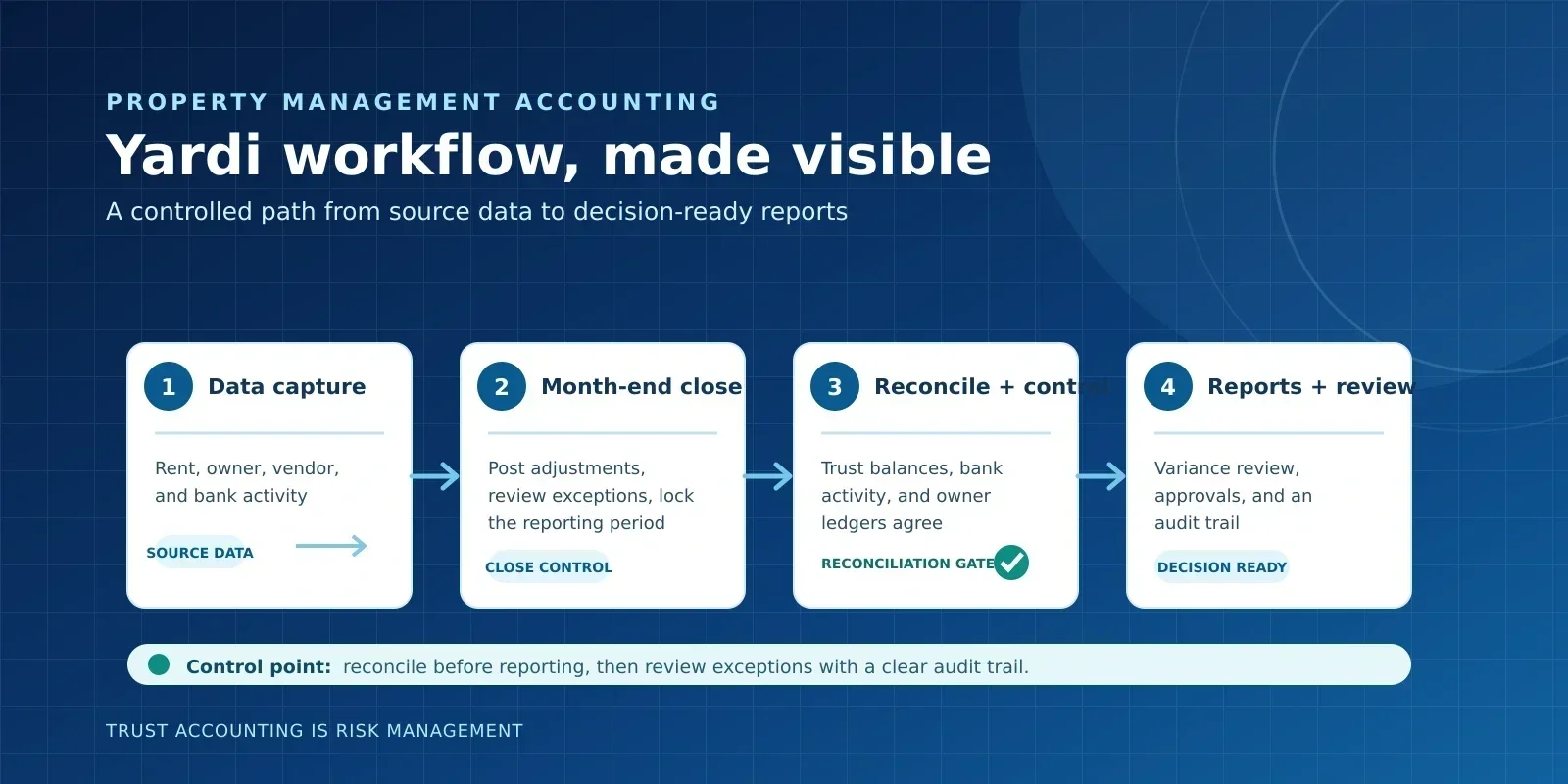
Yardi is a major name in property management software, but this guide does not assume a particular product version, configuration, or feature set. Property management companies use different Yardi products and set them up to fit different portfolios. Rather than treating a software label as proof that an accounting process is sound, use the framework below to assess your own records, responsibilities, and review steps. The aim is a repeatable accounting workflow that can be explained and supported with evidence.
What Should Property Managers Evaluate in Yardi Property Management Accounting?
Start with the financial process, not the software menu. A platform may hold transactions and reports, but the organization still needs clear rules for what belongs in each account, how entries are approved, and how balances are checked. The right assessment follows a transaction from its source through recording, review, reconciliation, and reporting.
Map one ordinary transaction and one exception. For example, follow a resident payment from receipt and posting through deposit and ledger review. Then follow a returned payment, reversal, or correction through authorization and documentation. A useful map identifies:
The source record: What document or activity supports the transaction?
The person responsible: Who enters it, who approves it, and who independently reviews it?
The accounting destination: Which property, owner, association, trust account, or operating account should receive the activity?
The evidence: What report, statement, approval, or reconciliation demonstrates that the step occurred?
The exception path: What happens when information is missing, a transaction is duplicated, or a balance does not agree?
This process map helps reveal whether staff rely on undocumented workarounds or individual memory. It also makes it easier to discuss a workflow with an accounting lead, software administrator, or outside specialist. Keep the review grounded in actual access and screens available to your team; do not assume that another company’s Yardi setup works the same way.
Make the map concrete by choosing a recent, completed transaction and writing down each handoff in sequence. For a vendor invoice, for example, note who receives it, what confirms the property and expense category, who authorizes payment, how the payment is recorded, and where the supporting invoice is retained. Then choose an exception, such as an invoice assigned to the wrong property. Record how the error was noticed, who approved the correction, and how the revised record can be distinguished from the original. This simple exercise tests whether the documented process reflects daily work.
It can help to label each step as a policy decision, an accounting task, a system action, or a review control. A system action is not automatically a control: selecting an account or producing a report may support the process, but someone still needs to confirm that the choice is appropriate and investigate unusual results. This distinction prevents a workflow review from turning into a list of menus without identifying who is accountable for the outcome.
How Do You Connect Property, Owner, and Trust Records?
Property management accounting often tracks activity at more than one level. A transaction might relate to a property, an owner, a tenant, an association, or an individual trust liability. An accounting review should establish how your organization distinguishes those relationships and how it checks the result. The underlying records should make it possible to explain who owns the funds and why a balance is being held.
For trust accounts, a core control is comparing the bank balance with the trust liability and the combined balances owed to individual owners or beneficiaries. This is often described as a three-way reconciliation. The organization should be able to show how the three figures were calculated, identify the date they represent, and document any differences rather than allowing a discrepancy to roll forward without explanation.
To examine that process in your Yardi environment, ask the accounting team to show the source for each total and how the figures are matched. Check whether:
Every applicable bank account is included in the review.
Individual owner or beneficiary balances are included in the aggregate comparison.
Transactions are recorded in the intended period and attached to the correct property or ledger.
Uncleared items, timing differences, and adjustments are described and tracked to resolution.
A reviewer who did not prepare the reconciliation can follow the calculation and supporting records.
A report that looks complete is not, by itself, evidence that every underlying balance is correct. Review whether the reporting period is clear, whether the account scope is appropriate, and whether source records support material entries. If you need a primer on the control itself, see this guide to trust accounting for property managers. For a deeper discussion of review frequency, see how often property managers should reconcile trust accounts.
A practical way to test the connection is to select one owner or beneficiary balance and trace it in both directions. Start from the individual balance and identify the transactions that make it up; then select one transaction and verify that it appears in the appropriate aggregate and account records. This is a sample check, not a substitute for a full reconciliation, but it can reveal whether coding conventions and supporting detail are understandable. Record the selection method and any limitation so another reviewer knows what was—and was not—tested.
Pay attention to how shared costs, transfers, security deposits, owner contributions, and distributions are classified in your own process. The right treatment depends on the facts and applicable requirements, so a review should not infer accounting treatment from a label alone. Ask what source document supports the classification, who can authorize a change, and whether the entry affects more than one ledger or entity. A clear answer helps prevent a correction in one place from leaving related balances inconsistent elsewhere.
How Should You Review Yardi Accounting Reports?
Reports are useful when they answer a defined question. Before relying on a report, write down the decision it supports, the population it covers, and its date range. A property-level balance report, for example, should be checked against the purpose for which the team uses it. A report with the wrong period, property selection, or account scope can appear orderly while omitting relevant activity.
Build a simple report review routine around these checks:
Confirm scope. Verify the entity, property, bank account, ledger, and reporting period included. Make sure filters and exclusions are understood.
Check completeness. Compare the report to an independent source where appropriate, such as a bank statement, approved transaction listing, or prior-period close schedule.
Look for unusual balances. Investigate negative, stale, unusually large, or unexplained balances. An unusual amount is a prompt to trace the details, not proof of an error by itself.
Trace a sample. Select representative transactions and follow each to its supporting record, approval, posting, and final presentation.
Record the review. Note who reviewed the report, when, what was checked, and how unresolved items will be handled.
For month-end, a report package should let a reviewer understand what was prepared and what remains open. A short close checklist can identify the reports produced, reconciliations completed, adjustments awaiting approval, and questions carried forward. Avoid relying on a folder of unexplained exports; name files consistently and preserve enough context to tell which version is final.
Reports should also be evaluated over time. If the same suspense balance or reconciliation item appears month after month, ask why it has not cleared. If a balance changes sharply, trace the movement to transactions and supporting details. A trend may point to a timing issue, a coding practice, or a process that needs attention. The goal is not to make every report look tidy; it is to understand what the report says and what action follows.
For each recurring report, keep a brief report inventory. Record its purpose, owner, period covered, account or property scope, reviewer, and the follow-up expected when a threshold or exception is reached. The inventory can be a simple checklist rather than a technical catalog. It is especially useful when staff change, when a portfolio grows, or when different teams use similar report names for different purposes. If two reports appear to show the same measure, determine which is authoritative for the relevant decision and why.
When reviewing a movement between periods, compare like with like. Confirm that the entities and dates match, then identify the transactions responsible for the change instead of relying only on a total-level comparison. For example, if a payable balance drops substantially, a reviewer can select the larger changes and connect them to approved payments or adjustments. If the explanation cannot be traced to transaction-level records, note the missing evidence and assign a follow-up owner. This makes review comments actionable rather than simply recording that a number looks different.
What Should a Monthly Reconciliation Workflow Include?
A dependable reconciliation routine starts before the review date. Assign responsibility for obtaining statements and transaction records, setting the period cutoff, preparing the reconciliation, and completing a separate review. Document the expected timing and escalation path. The exact cadence should reflect account activity, applicable obligations, and the organization’s control needs; a calendar reminder alone does not establish that the work is complete.
At a minimum, a reconciliation file should identify the account and period, the statement balance, the accounting balance, outstanding items, any adjustments, and the preparer and reviewer. Supporting records should make it possible to trace an item without relying on the preparer’s memory. If someone makes a correction, preserve its reason and approval rather than silently changing a figure.
When a reconciliation does not balance, use a structured investigation rather than a plug entry. First confirm the account, date range, beginning balance, and statement used. Then compare transactions on both sides, paying close attention to duplicates, omissions, reversals, timing differences, and entries assigned to an incorrect property or account. Determine whether an item is a genuine outstanding transaction or a bookkeeping error. Record the finding, the action taken, and the person responsible for follow-up.
For instance, suppose a bank statement includes a payment that the accounting records do not show. Do not simply enter a balancing amount. Check the payee, transaction date, authorization, and related property or owner record; then determine whether the payment was omitted, recorded in another period, or assigned to the wrong account. If a correction is needed, document the entry and its approval and make sure the revised balance is reviewed. If it is a legitimate timing difference, describe why it remains outstanding and when it will be checked again.
Classify reconciliation items so the reviewer can tell what kind of follow-up is required. A pending deposit may need confirmation that it cleared; a duplicate posting may require a correction; a stale check may require research under the company’s procedures; and an unexplained difference may need escalation. Include an age or next-review date where useful. A list of open items without owners or next steps tends to become a permanent carry-forward schedule rather than a control.
Some teams find that a weekly review of activity helps them identify issues sooner, while others use a monthly process supported by interim monitoring. The appropriate schedule depends on transaction volume, risk, staffing, and applicable rules. Our article on weekly versus monthly trust reconciliation outlines considerations for setting a routine. Northstar also describes its monthly trust account reconciliation services for property management companies.
Close the loop after review. The preparer should respond to questions with documents or a clear explanation, and the reviewer should mark whether each item is resolved or still open. Maintain a short outstanding-items schedule with the issue, amount or affected account where appropriate, origin date, assigned person, next action, and status. At the next close, revisit every carried item instead of assuming that a prior note remains accurate. This helps separate normal timing items from recurring process problems.
How Can You Set Clear Roles and Review Controls?
Accounting controls should work even when a team member is out or responsibilities change. Separate transaction preparation from approval and review where staffing allows. In smaller teams, full separation may not be practical; document a compensating review that gives an appropriate person visibility into activity and supporting records. The important point is that one person should not be the only source of information about a critical balance.
Use a responsibility list to clarify who handles recurring tasks. It can include bank statement access, transaction entry, payment approval, reconciliations, report review, adjustments, and month-end signoff. For each task, name a primary owner, a backup, and the evidence of completion. Review the list when staff roles, portfolio structure, bank accounts, or software access change.
Access should match assigned responsibilities. Periodically review who can create, edit, approve, or remove accounting information and whether those permissions remain appropriate. Keep a process for promptly removing access when duties change or a person leaves. Do not share user credentials as a substitute for a workable approval process. The organization should follow its own security policies and the controls available in its configuration.
Written procedures should be practical enough that a trained colleague can follow them. A useful procedure names the purpose, inputs, steps, review point, records to retain, and escalation contact. It should not promise that a particular screen or button is available in every Yardi environment. Verify product-specific instructions against the organization’s own implementation, documentation, and authorized support channels.
A role matrix can expose gaps before they become urgent. For each recurring task, list who prepares, who approves, who reviews, and who serves as backup. If the same person performs more than one role, note what additional review is used and what evidence that reviewer receives. This is more informative than a generic statement that duties are segregated because it shows the actual control design and its limits.
Also define how changes are communicated. When a new bank account, property, association, or approval rule is introduced, specify who confirms the accounting setup, who updates written procedures, and who verifies the first period’s activity. When a staff member is absent, the backup should know where source documents and checklists are kept and how to escalate an unresolved item. A documented handoff protects continuity without assuming that every task can be automated.
What Does California DRE Compliance Change?
Property managers should identify the rules that apply to their company, accounts, services, and jurisdiction. California firms subject to Department of Real Estate requirements have additional state-specific trust account obligations. The California Department of Real Estate is the official starting point for its information; confirm the current rules and consult qualified compliance or legal advisers for questions about how they apply to a specific operation.
A software system does not determine whether a company has met a legal requirement. The company remains responsible for using appropriate procedures, keeping required records, and addressing discrepancies. For California property managers, a compliance review should connect written policies to actual practices: who controls the accounts, how records are reconciled, how the company handles shortages or unresolved items, and where evidence is retained.
Teams should avoid treating a completed reconciliation as a guarantee of compliance. A reconciliation is one control within a larger system. Review the relevant rules, account structure, recordkeeping process, and responsible roles together. Northstar’s California DRE trust account compliance support page describes the company’s focus in this area. For operational preparation, also see the California DRE audit preparation checklist.
For a company operating in multiple states, do not assume that one state’s procedures satisfy another jurisdiction’s requirements. Maintain a way to identify the rules relevant to each operation and account, and assign responsibility for checking changes with appropriate sources or advisers. The accounting workflow should make it possible to retrieve the records needed for a review, but the company should not treat a generic checklist as a replacement for jurisdiction-specific advice.
During a compliance-oriented workflow review, test whether the team can explain the purpose of each trust account, identify which funds it holds, and produce a coherent record of reconciliations and follow-up. Ask how unresolved differences are elevated and who makes decisions about corrective action. These questions connect written controls to actual practice without implying that a software report by itself proves that all applicable requirements have been met.
How Do You Prepare for a Yardi Workflow Review?
A review is more useful when it has a defined scope. Decide whether you are assessing a recurring close, trust-account reconciliation, report package, data conversion, or a broader accounting handoff. Gather the records that explain the current process, but protect sensitive information and share it only through authorized channels.
Prepare a concise inventory:
Entities, properties, associations, and bank accounts in scope.
Yardi product or configuration details known to the team, without assuming all users have the same version.
Recurring reports and reconciliations, their owners, reviewers, and due dates.
Written procedures, close checklists, and approval rules currently in use.
Open questions, old reconciling items, repeated corrections, and any recent workflow changes.
What the review should produce, such as a documented process map, a prioritized issue list, or clarified responsibilities.
Then walk through the process with the people who do the work. Ask them to demonstrate how an ordinary transaction is handled and how an exception is resolved. Compare the demonstration with the written procedure and the evidence retained. A mismatch does not automatically mean misconduct; it may signal that procedures are outdated, unclear, or too difficult to follow. Capture the difference and agree on the next step.
Prioritize findings by their potential effect on fund accuracy, reporting reliability, deadlines, and continuity. An unresolved trust balance or unclear account ownership usually deserves more attention than a cosmetic report preference. Assign each issue an owner and due date, and record whether it requires a policy decision, staff coordination, software configuration review, or specialist input.
Before the review meeting, decide how to handle sensitive records. Use the organization’s approved sharing method, limit access to people who need the information, and avoid putting resident, owner, or banking details into an informal checklist. A reviewer can often begin with redacted examples or a controlled demonstration, then request additional documentation through an authorized channel if needed. Record what materials were examined without keeping unnecessary copies.
At the end, turn findings into a short action register. Each item should describe the observed condition, why it matters, evidence reviewed, proposed next step, accountable owner, and target date. Separate confirmed issues from questions that still need research. If a finding depends on product-specific behavior, assign a system administrator or authorized support contact to verify it rather than guessing from another company’s setup. Revisit the register until each item is resolved, accepted with a documented rationale, or escalated.
A useful review does not need to redesign every process at once. Start with the highest-risk gaps, such as an unexplained trust balance, missing approval evidence, or an unclear close owner. Agree on a manageable corrective action and a way to verify it worked in the next cycle. Then move to lower-priority improvements, such as clearer file names or a more useful report inventory. Sequencing work this way gives the team a practical path from observation to sustained control.
When Should a Property Management Company Seek Accounting Support?
Outside support may be worth considering when reconciliations are repeatedly late, balances cannot be explained, staff are unsure who approves adjustments, or a portfolio change has outpaced existing procedures. A company may also need temporary help to organize historical records, establish a consistent close routine, or clarify accounting leadership responsibilities. The right scope depends on the situation; an advisor should first understand the portfolio, current process, system configuration, and applicable requirements.
Choose support based on relevant property management accounting experience and a clear description of responsibilities. Ask how work will be documented, who reviews it, how unresolved issues are escalated, and what information your team must provide. Confirm whether the provider's software experience matches your environment. Northstar specializes in property management trust accounting and related financial operations, while its established platform-specific support is centered on AppFolio. Do not assume that its AppFolio focus means it provides Yardi implementation or product support.
Before engaging any provider, define the boundaries between your team and the outside resource. Clarify who retains decision authority, who has access to records, who communicates with owners or other stakeholders, and which work remains with the company. Good coordination supports continuity; it does not transfer the property manager’s responsibility to maintain appropriate controls.
In an initial discussion, describe the actual accounting problem rather than beginning with a request for a particular software change. For example, explain which reconciliation is delayed, how long the issue has remained open, what evidence is available, and what outcome your team needs. Ask the prospective resource to state what is included, what is outside scope, how questions are escalated, and what information will be returned to your staff. This keeps expectations clear and helps determine whether the need is process support, trust accounting work, leadership capacity, or product-specific assistance.
A support engagement should leave the company better able to understand its own records and responsibilities. Agree in advance on the working papers or status updates the team will receive, how open items will be tracked, and who approves adjustments or policy decisions. Keep company personnel involved in decisions that remain their responsibility, and review access permissions for any external participant. These boundaries help make handoffs orderly and make work easier to continue when an engagement ends.
What Should Property Managers Remember?
Evaluate Yardi property management accounting by tracing records and checking controls, not by assuming that software alone ensures accurate books. Define the financial process, verify reports against supporting evidence, document reconciliations and exceptions, and make roles clear. Review product-specific details in the context of your own configuration and applicable requirements.
Keep the review practical. Choose a transaction, a report, and a reconciliation; walk each from source to review evidence. Record what works, what is unclear, and who will resolve each gap. This approach can help a property management company create a more explainable accounting process without presuming that every organization uses the same tools or workflows.
Request a Consultation to discuss your property management accounting needs.
Frequently Asked Questions
Does Northstar provide Yardi implementation or software support?
Northstar’s documented platform-specific focus is AppFolio accounting support. The available company information does not establish Yardi implementation or product support, so confirm the scope directly before seeking assistance with Yardi configuration.
Can Yardi guarantee that a trust account is compliant?
No software platform alone can guarantee compliance. Property managers need appropriate procedures, accurate records, timely reconciliation, clear review responsibilities, and an understanding of the rules that apply to their operations.
What should a three-way trust reconciliation compare?
It should compare the applicable bank balance, the trust liability balance, and the combined individual owner or beneficiary ledger balances for the same point in time. Document the source of each amount and investigate differences rather than carrying them forward without explanation.
How often should a property management team reconcile?
The appropriate frequency depends on transaction activity, applicable obligations, and the organization’s risk and control needs. Establish a written schedule, assign a preparer and reviewer, and make sure exceptions are tracked through resolution.
A clear process and review trail help your team understand what each balance means and respond when something does not match.
